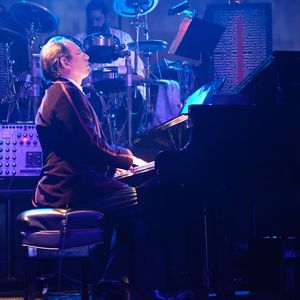
Hans Zimmer (born September 12, 1957) is a world renowned German pianist, film composer and music producer, hailing from Frankfurt am Main, West Germany.
Born to a musical mother and an inventive, engineering father, Zimmer took piano lessons at an early age however stopped after a few weeks not liking the discipline of formal lessons. After this time Zimmer began experimenting with the piano, making modifications to its design by adding the likes of chainsaws, which marked the beginning of Hans Zimmer’s excursions into electronic synthesisers.
After moving to England, Zimmer began writing the music for television commercials during which time he met the musicians Trevor Horn and Geoff Downes and formed the rock group entitled The Buggles. The band subsequently released the worldwide smash hit “Video Killed the Radio Star”, which became the first ever video broadcasted on MTV in 1979.
Citing the influences of composers Ennio Morricone, Elmer Bernstein, John Barry, and more notably Stanley Meyers, Zimmer directed his efforts to writing film scores, using both classical and electronic techniques of sound production. After founding Lillie Yard Studios in London alongside Stanley Meyers, the pair scored the soundtracks to the films, “Moonlighting”, “Success is The Best Revenge”, “Insignificance” and the hit “My Beautiful Launderette”. The success of these soundtracks introduced Zimmer to Hollywood, and was subsequently invited to assist Ryuichi Sakamoto and David Byrne score Bertolucci’s epic “The Last Emperor”.
After a handful of other film scores including “Wonderland”, “Paperhouse”, “Burning Secret”, and “A World Apart” in 1986, Zimmer was enlisted to compose the soundtrack for “Rain Man” featuring Tom Cruise and Dustin Hoffman. The soundtrack led to an Oscar nomination and Zimmer becoming the go-to guy for scoring high-profile prestige films including “Driving Miss Daisy”, “Days of Thunder”, and “Backdraft”. By this time Zimmer had focused his attentions on writing action movie scores for the likes of “Thelma and Louise”, “Peacemaker”, and Grammy Award-winning “Crimson Tide”.
After scoring “The Power of One” in 1992 using African choirs and drums, Walt Disney Animation Studios contacted Zimmer to compose the soundtrack for “The Lion King”. Zimmer subsequently won an Academy Award for Best Original Score, a Golden Globe, and two Grammys for the soundtrack. The musician continued to compose soundtracks for a stream of films throughout the 2000s including “Gladiator”, “The Last Samurai”, The Da Vinci Code”, “Pirates of the Caribbean”, “Sherlock Holmes” and “Inception”. The result of which turned Zimmer into one of the most respected film composers in the world, earning a star on the “Boulevard der Stars” in Berlin, Germany, four Grammy Awards, two Golden Globes, and four Classical BRIT Awards.
 Hannah Cohen


 Inicia sesión en tu cuenta